Clothes Made From Art Gallery Indelible Jersey Knit Stamped Grove Daylight

A woman wearing a pinkish V-cervix T-shirt
A T-shirt, or tee shirt, is a style of fabric shirt named afterward the T shape of its trunk and sleeves. Traditionally, information technology has short sleeves and a round neckline, known as a crew neck, which lacks a collar. T-shirts are generally made of a stretchy, low-cal, and inexpensive fabric and are piece of cake to clean. The T-shirt evolved from undergarments used in the 19th century and, in the mid-20th century, transitioned from undergarment to general-use casual clothing.
They are typically made of cotton fabric in a stockinette or jersey knit, which has a distinctively pliable texture compared to shirts made of woven cloth. Some modern versions have a torso made from a continuously knitted tube, produced on a circular knitting machine, such that the torso has no side seams. The manufacture of T-shirts has become highly automated and may include cutting textile with a laser or a water jet.
T-shirts are inexpensive to produce and are ofttimes part of fast mode, leading to outsized sales of T-shirts compared to other attire.[one] For case, two billion T-shirts are sold per year in the United States,[2] or the average person from Sweden buys nine T-shirts a yr.[3] Production processes vary but tin can exist environmentally intensive, and include the environmental impact caused by their materials, such as cotton which is both pesticide and water intensive.[four] [5] [six]
History [edit]
Elementary, T-shaped top garments accept been a office of human clothing since ancient times; garments similar to the T-shirt worn earlier in history are generally chosen tunics.
The modern T-shirt evolved from undergarments used in the 19th century. Offset, the one-piece matrimony adjust underwear was cut into separate summit and bottom garments, with the top long plenty to tuck under the waistband of the bottoms. With and without buttons, they were adopted by miners and stevedores during the late 19th century as a convenient covering for hot environments.
Equally slip-on garments without buttons, the earliest T-shirt dates dorsum to sometime between the 1898 Castilian–American State of war and 1904, when the Cooper Underwear Visitor ran a mag ad announcing a new product for bachelors. In the "before" photograph, a homo averts his eyes from the photographic camera every bit if embarrassed; he has lost all the buttons on his undershirt and has safety-pinned its flaps together. In the "after" photograph, a virile gentleman sports a handlebar mustache, smokes a cigar and wears a "bachelor undershirt" stretchy enough to be pulled over the head. "No condom pins — no buttons — no needle — no thread", ran the slogan aimed at men with no wives who lacked sewing skills.[7]

In 1913, the U.S. Navy first issued them as undergarments.[8] These were a coiffure-necked, short-sleeved, white cotton undershirt to be worn under a compatible. It became common for sailors and Marines in work parties, the early on submarines, and tropical climates to remove their compatible jacket, thus wearing (and soiling) only the undershirt.[9] They soon became popular as a bottom layer of clothing for workers in various industries, including agriculture. The T-shirt was easily fitted, easily cleaned, and inexpensive; for those reasons, it became the shirt of option for young boys. Boys' shirts were made in various colors and patterns. The discussion T-shirt became part of American English by the 1920s, and appeared in the Merriam-Webster Dictionary.[viii]

By the Slap-up Depression, the T-shirt was oft the default garment to be worn when doing farm or ranch chores, as well as other times when modesty called for a torso roofing but conditions called for lightweight fabrics.[9] Following Earth War Two, it was worn past Navy men as undergarments and slowly became common to encounter veterans wearing their compatible trousers with their T-shirts equally coincidental article of clothing. The shirts became even more popular in the 1950s later Marlon Brando wore one in A Streetcar Named Desire, finally achieving status as stylish, stand-lonely, outerwear garments.[10] Often boys wore them while doing chores and playing outside, eventually opening upward the idea of wearing them as general-purpose coincidental wearable.
Printed T-shirts were in limited employ by 1942 when an Air Corps Gunnery School T-shirt appeared on the cover of Life magazine. In the 1960s, printed T-shirts gained popularity for self-expression as well as for advertisements, protests, and souvenirs.
Current versions are available in many different designs and fabrics, and styles include crew-neck and 5-cervix shirts. T-shirts are among the most worn garments of article of clothing used today. T-shirts are especially pop with branding for companies or merchandise, every bit they are inexpensive to make and buy.
Trends [edit]
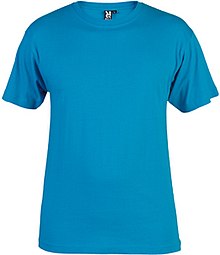
T-shirts were originally worn as undershirts, but are now worn frequently equally the merely piece of clothing on the top half of the body, other than perchance a brassiere or, rarely, a waistcoat (belong). T-shirts have as well get a medium for self-expression and advertising, with whatsoever imaginable combination of words, art and photographs on display.[11]
A T-shirt typically extends to the waist. Variants of the T-shirt, such as the V-neck, take been developed. Hip hop manner calls for tall-T shirts which may extend down to the knees. A similar item is the T-shirt apparel or T-dress, a clothes-length T-shirt that tin can be worn without pants.[12] Long T-shirts are also sometimes worn by women as nightgowns. A 1990s trend in women's clothing involved tight-fitting cropped T-shirt or crop tops short enough to reveal the midriff. Another less popular trend is wearing a brusk-sleeved T-shirt of a contrasting color over a long-sleeved T-shirt, which is known as layering. T-shirts that are tight to the body are called fitted, tailored or babe doll T-shirts.
With the ascent of social media and video sharing sites also came numerous tutorials on DIY T-shirt projects.[13] These videos typically provided instructions on how to modify an erstwhile shirt into a new, more than fashionable form.
Expressive messages [edit]
Since the 1960s, T-shirts have flourished as a form of personal expression.[11] Screen printed T-shirts accept been a standard form of marketing for major American consumer products, such as Coca-Cola and Mickey Mouse, since the 1970s. It has as well been commonly used to commemorate an event or to make a political or personal statement. Since the 1990s, information technology has become common practice for companies of all sizes to produce T-shirts with their corporate logos or messages equally part of their overall advertising campaigns. Since the late 1980s and especially the 1990s, T-shirts with prominent designer-name logos take become popular, especially with teenagers and young adults. These garments allow consumers to flaunt their taste for designer brands in an inexpensive way, in addition to being decorative. Examples of designer T-shirt branding include Calvin Klein, FUBU, Ralph Lauren, American Wearing apparel, and The Gap. These examples besides include representations of rock bands, among other obscure popular-culture references. Licensed T-shirts are besides extremely popular. Movie and Tv set T-shirts can have images of the actors, logos, and funny quotations from the movie or Television bear witness. Often, the most pop T-shirts are those that characters wore in the film itself (due east.g., Bubba Gump from Forrest Gump and Vote For Pedro from Napoleon Dynamite).
Designer Katharine Hamnett, in the early 1980s, pioneered outsize T-shirts with large-print slogans. The early start decade of the 21st century saw the renewed popularity of T-shirts with slogans and designs with a stiff inclination to the humorous and/or ironic. The tendency has simply increased later on in this decade, embraced by celebrities, such as Britney Spears and Paris Hilton, and reflected dorsum on them, besides ('Squad Aniston'). The political and social statements that T-shirts often brandish have become, since the first decade of the 21st century, one of the reasons that they have so deeply permeated different levels of culture and society. The statements also may be found to be offensive, shocking, or pornographic to some. Examples of T-shirt stores and designers known for using offensive and shocking messages include T-Shirt Hell and Apollo Braun. Many different organizations have defenseless on to the argument-making trend, including chain and independent stores, websites, and schools.
A popular phrase on the front end of demonstrating the popularity of T-shirts amongst tourists is the humorous phrase "I went to _____ and all I got was this lousy T-shirt." Examples include "My parents went to Las Vegas and all I got was this lousy T-shirt." T-shirt commutation is an activity where people trade the T-shirts that they are wearing.
Artists similar Bill Beckley, Glen Baldridge and Peter Klashorst apply T-shirts in their work. Models such equally Victoria Beckham and Gisele Bundchen wore T-shirts through the 2000s. Paris Fashion Week 2014 featured a grunge way T-shirt.[14]
Decoration [edit]

Ringer T-shirt
In the early 1950s, several companies based in Miami, Florida, started to decorate T-shirts with unlike resort names and various characters. The start company was Tropix Togs, under founder Sam Kantor, in Miami. They were the original licensee for Walt Disney characters in 1976 including Mickey Mouse and Davy Crockett. Later, other companies expanded into the T-shirt printing business, including Sherry Manufacturing Company, as well based in Miami. Sherry was founded in 1948 by its owner and founder Quentin H. Sandler as a screen printer of Souvenir Scarf'southward to the souvenir resort marketplace. Before long, the visitor evolved into one of the largest screen printed resort and licensed apparel companies in the The states. The company now (2018) runs automatic Screen Print presses and produces upward to 10,000 to xx,000 T-shirts each day.
In the 1960s, the ringer T-shirt appeared and became a staple manner for youth and rock-n-rollers. The decade also saw the emergence of tie-dyeing and screen-printing on the bones T-shirt and the T-shirt became a medium for wear fine art, commercial advertising, gift letters, and protest fine art letters. Psychedelic fine art poster designer Warren Dayton pioneered several political, protest, and pop-culture art printed large and in colour on T-shirts featuring images of Cesar Chavez, political cartoons, and other cultural icons in an article in the Los Angeles Times magazine in late 1969 (ironically, the clothing company quickly cancelled the experimental line, fearing there would not be a marketplace). In the belatedly 1960s, Richard Ellman, Robert Tree, Bill Kelly, and Stanley Mouse fix the Monster Visitor in Mill Valley, California, to produce fine art designs expressly for T-shirts. Monster T-shirts often characteristic emblems and motifs associated with the Grateful Dead and marijuana culture.[fifteen] Additionally, i of the most popular symbols to emerge from the political turmoil of the 1960s were T-shirts begetting the confront of Marxist revolutionary Che Guevara.[16]
Today, many notable and memorable T-shirts produced in the 1970s take get ensconced in popular culture. Examples include the vivid xanthous happy face T-shirts, The Rolling Stones tops with their "tongue and lips"[17] logo, and Milton Glaser'south iconic "I ♥ N Y" design. In the mid-1980s, the white T-shirt became stylish after the actor Don Johnson wore it with an Armani adjust in Miami Vice.[9]
V-Cervix [edit]
A 5-neck T-shirt has a 5-shaped neckline, as opposed to the round neckline of the more mutual crew neck shirt (as well called a U-cervix). V-necks were introduced so that the neckline of the shirt does not show when worn beneath an outer shirt, as would that of a crew neck shirt.[eighteen] [19] [20]
Screen printing [edit]

A woman wearing a T-shirt with an architectural motif
The almost mutual form of commercial T-shirt ornament is screen press. In screen printing, a design is separated into private colors. Plastisol or h2o based inks are applied to the shirt through mesh screens which limits the areas where ink is deposited. In almost commercial T-shirt press, the specific colors in the design are used. To achieve a wider color spectrum with a express number of colors, process press (using only cyan, magenta, yellow and black ink) or simulated process (using only white, black, ruby-red, green, blue, and gold ink) is effective. Process printing is all-time suited for lite colored shirts.[21] The simulated procedure is best suited for nighttime colored shirts.
In 1959, the invention of plastisol provided an ink more durable and stretchable than water-based ink, allowing much more than diversity in T-shirt designs. Very few companies continue to use water-based inks on their shirts. The majority of companies that create shirts adopt plastisol due to the ability to print on varying colors without the need for colour adjustment at the art level.
Specialty inks tendency in and out of style and include shimmer, puff, discharge, and chino based[22] inks. A metal foil can be heat pressed and stamped onto whatever plastisol ink. When combined with shimmer ink, metallics requite a mirror like consequence wherever the previously screened plastisol ink was applied. Specialty inks are more expensive to buy also as screen and tend to appear on garments in boutiques.
Other methods of decoration used on T-shirts include airbrush, applique, embroidery, impressing or embossing, and the ironing on of either flock lettering, estrus transfers, or dye-sublimation transfers. Light amplification by stimulated emission of radiation printers are capable of press on plain paper using a special toner containing sublimation dyes which can then exist permanently rut-transferred to T-shirts.
In the 1980s, thermochromatic dyes were used to produce T-shirts that changed color when subjected to heat. The Global Hypercolour brand of these was a mutual sight on the streets of the UK for a few years but has since mostly disappeared. These were as well very popular in the U.s. amongst teenagers in the tardily 1980s. A downside of color-change garments is that the dyes tin can easily be damaged, especially by washing in warm water or dye other clothes during washing.
Tie dye [edit]
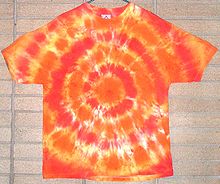
Tie dye originated in India, Nihon, Jamaica, and Africa as early as the sixth century.[23] Some forms of tie dye are Bandhani (the oldest known technique) used in Indian cultures, and Shibori primarily used in Japanese cultures. It was not until the 1960s that tie dye was introduced to America during the hippie movement.[23]
Heat transfer vinyl (HTV) [edit]
Another form of T-shirt decoration is heat transfer vinyl, also called HTV. HTV is a polyurethane textile that allows wearing apparel designers to create unique layered designs using a specialized software program. Once the design is created, it is then cut through the material using a vinyl cutter (or Cut northward Press) automobile.
There are dozens of different colors available, likewise as glitter, reflective, and at present even unique patterns (such as mermaid pare) which come in rolls and sheets.
After the design is cut, there is a process called "weeding" whereby the areas of the design that do not represent the design are picked abroad from the transfer sheet and removed so that the intended design remains. HTV is typically smooth to the affect and does not feel rubbery or potent. The edges are typically make clean cutting and produce high contrast.
Designers can besides create multiple color designs, or multi-layered designs using HTV. This process would be done in the design software before the design is sent to the cutter for the unlike materials. A heat press is and then used to apply force per unit area and estrus to the vinyl so that the material permanently adheres to the garment. The temperature and pressure vary co-ordinate to the manufacturers specifications.

Dye-sublimation printing [edit]
Dye-sublimation printing is a directly-to-garment digital printing applied science using full color artwork to transfer images to polyester and polymer-coated substrate based T-shirts. Dye-sublimation (also commonly referred to as all-over printing) came into widespread utilise in the 21st century, enabling some designs previously impossible. Printing with unlimited colors using large CMYK printers with special newspaper and ink is possible, unlike screen printing which requires screens for each color of the design. All-over impress T-shirts have solved the problem with color fading and the vibrancy is college than nearly standard printing methods but requires synthetic fabrics for the ink to take hold. The central feature of dye-sublimated clothing is that the design is non printed on acme of the garment, but permanently dyed into the threads of the shirt, ensuring that it will never fade.
Dye-sublimation is economically viable for pocket-sized-quantity printing; the unit toll is similar for brusk or long production runs. Screen printing has higher setup costs, requiring large numbers to be produced to be price-constructive, and the unit of measurement cost is higher.
Solid ink is changed into a gas without passing through a liquid stage (sublimation), using heat and pressure. The design is first produced in a figurer paradigm file format such as jpg, gif, png, or any other. It is printed on a purpose-made computer printer (as of 2016[update] almost commonly Epson or Ricoh brands)[ citation needed ] using big heat presses to vaporize the ink directly into the fabric. Past mid-2012, this method had get widely used for T-shirts.
Other methods [edit]
Before the hippie movement Rit Dye was known as a hobby for older women. Other methods of decorating shirts include using paints, markers, fabric transfer crayons, dyes, spray pigment, and many more. Some techniques that can be used include sponging, stenciling, daubing, stamping, screen printing, bleaching, and many more.[24] As technology advances, it offers more than experimentations and possibilities for designers and artists to seek for innovative techniques with their T-shirts. Some new T-shirt creators have used designs with multiple avant-garde techniques, which includes using glow-in-the-dark inks, heat-sensitive fabrics, foil printing and all-over press. Other designers similar Robert Geller, a German-built-in American style designer, has created unique T-shirt collections such as Seconds which feature oversized graphic T-shirts made from super soft bailiwick of jersey materials. Alexander Wang, on the other paw, came out with variations of T-shirts from oversized scoop necks, tanks to striped, slouchy rayon jerseys.[25] Artists like Terence Koh, took a different approach, with T-shirts featuring an upside down portrait with a existent bullet hole hand finished past him for the Soho store Opening Ceremony.[26]
See also [edit]
- Concert T-shirt
- Inkjet transfer
- Kit (association football)
- Polo shirt
- Printed T-shirt
- Raglan sleeve
- Wet T-shirt competition
References [edit]
- ^ "A Breakdown of the Environmental Impact of a Cotton fiber T-Shirt – Treefy". Retrieved 2021-02-27 .
- ^ Wall, Mattias; er; ContributorCEO; USAgain (2012-07-03). "T-Shirt Blues: The Environmental Impact of a T-Shirt". HuffPost . Retrieved 2021-02-27 .
- ^ Hurst, Nathan. "What'due south the Environmental Footprint of a T-Shirt?". Smithsonian Magazine . Retrieved 2021-02-27 .
- ^ Hurst, Nathan. "What'south the Environmental Footprint of a T-Shirt?". Smithsonian Magazine . Retrieved 2021-02-27 .
- ^ Wall, Mattias; er; ContributorCEO; USAgain (2012-07-03). "T-Shirt Blues: The Environmental Bear upon of a T-Shirt". HuffPost . Retrieved 2021-02-27 .
- ^ "A Breakdown of the Environmental Affect of a Cotton T-Shirt – Treefy". Retrieved 2021-02-27 .
- ^ "Who Made That T-Shirt?". The New York Times. 22 September 2013. Retrieved 6 November 2020.
- ^ a b "History of the T-shirt". Tee Fetch.
- ^ a b c Harris, Alice. The White T. HarperCollins, 1996.
- ^ "A Streetcar Named Desire – AMC filmsite". Filmsite.org. 1947-12-03. Retrieved 2010-ten-26 .
- ^ a b Sally Larsen with Neeli Cherkovski, Japlish, Pomegranate Art Books, San Francisco, 1993, ISBN 1-56640-454-1
- ^ Cumming, Valerie; C. W. Cunnington & P. E. Cunnington (2010). The Lexicon of Manner History. Berg Publishers. p. 211. ISBN978-1-84788-534-0.
- ^ "31 T-Shirt DIYs That Are Perfect For Summer". Buzzfeed.com . Retrieved ane July 2016.
- ^ Pieri, Kerry (2013-ten-03). "Street style: Paris fashion week 2014". Archived from the original on 2014-05-xxx. Retrieved 2018-03-13 .
- ^ Monster T-shirt ART, Monster Corporation catalog #3, Manufacturing plant Valley 1974
- ^ The Most Famous Argument T-shirts by SoJones Asmara, September ten, 2009
- ^ File:The Rolling Stones Tongue Logo.png
- ^ "Crew neck". Merriam-Webster Online . Retrieved 2 August 2010.
- ^ "Sweaters Go Bulky". Milwaukee Journal Sentinel. 25 August 1957. p. 2. Retrieved two Baronial 2010.
- ^ Kirby, Michael B. (Spring 2008). "90th IDPG History of the T-shirt During WW2". 90th Infantry Division Preservation Group. Retrieved two August 2010.
- ^ Steve Rhodes. "CMYK Printing". ImpressionzPrinting.com.
CMYK is a widely used technique to replicate total-colour images on light colored backgrounds. The full-color process originated to accurately reproduce artwork on white paper.
- ^ Huston, Lance. "Subject: Re: chino ink??". ScreenPrinters.Net. Archived from the original on 23 September 2013. Retrieved xiii January 2018.
Chino is a special Rutland INK Base of operations mixing system.… While on the surface it looks similar to a reduced base, it does have a unique print quality to it that offers a waterbase feel, without the hassles of waterbase inks.
- ^ a b "Peace, Beloved and Necktie-Dye". Iml.jou.ufl.edu . Retrieved 31 October 2017.
- ^ Taylor, Ballad. The Great T-Shirt Book!: Brand Your Own Spectacular, One-of-a-kind Designs. New York: Sterling Pub., 1992. Print.
- ^ "T-Shirt by Darwin". NYMag.com . Retrieved 2017-05-23 .
- ^ "Bullet Hole Tees: Terence Koh'south Sheathing T-Shirt Collection for Opening Ceremony". TrendHunter.com . Retrieved 2017-05-23 .
External links [edit]
Source: https://en.wikipedia.org/wiki/T-shirt
0 Response to "Clothes Made From Art Gallery Indelible Jersey Knit Stamped Grove Daylight"
Post a Comment