How Do U Know Ur Baby Differentiates Between Mommy and Others
Newborn babies are bare sheets of paper. I must teach them and help them recognize the world, simply 1 thing that they seem to know is the identity of their mother. And then, how are babies able to recognize their maternal figure?
Having babies is like having a piece of your middle in your hands. A piece of your heart to look at, to tickle, to feed, and to entertain. A babe is a slice of your middle that was then deeply attached to you lot for the last nine months, which is where the worry starts to kick in for some mothers… What if this slice of your heart isn't able to recognize you?
As it turns out, newborn babies are more intelligent than nosotros thought them to exist. They may non have any knowledge of the real earth, only these new, adorable, tiny humans can recognize their moms.
In fact, other species of the animal world can recognize their mothers as well. Mice and other mammal neonates can identify their mothers using a similar mechanism as human neonates.
A human newborn makes employ of its senses to differentiate its mother from other individuals. Fathers out there, don't worry, your infant will recognize you as well, merely commencement, the mom.
Sense of hearing
Remarkably, newborn babies have their sense of hearing activated even before they come up out into the world. Man fetuses can hear the maternal vocalization when they're in the womb itself.
A babe in the womb can hear mum's vox and can recognize it from the third trimester onwards. Nearly 30 weeks into the gestational period, the mechanisms (sensory and encephalon) have developed enough to allow this, pregnant that babies in the womb can hear and recognize their mom'south voice in the final 10 weeks of the pregnancy.
Remarkably enough, babies can also hear their mother's heartbeats and rhythmic claret flow.
Withal, the maternal vocalisation that the fetus hears is low in sound and quite muffled. Information technology hears the maternal voice as it is transferred through the mother's bones and amniotic fluid.
Babies can recognize mom'southward voice fifty-fifty before birth. (Photo Credit : leungchopan/Shutterstock)
A study showed that even pre-term babies were able to recognize their mother'due south voice. In the research conducted, it was shown that babies who heard their female parent's vocalisation sucked harder and longer on a pacifier. Furthermore, babies who were exposed to unfamiliar female person voices did not show any such behavior.
After a baby has come out into world, it naturally starts giving more than preference to the maternal voice, due to familiarity. Pre-natal exposure therefore plays an important role in recognition. The baby'south identification improves with continuous exposure to its mom'southward voice.
Gradually, the baby becomes experienced enough to fifty-fifty differentiate the voices of its dad and other family members from unfamiliar people.
Sense of aroma
Similar the sense of hearing, the sense of olfactory property develops and becomes functional while the infant is in the womb itself, but what is in that location to smell in the uterus? Amniotic fluid!
An amnion is a bag that surrounds the fetus in the uterus. It is filled with a fluid called amniotic fluid. This is the same fluid that comes out when a adult female'southward "water breaks". The baby is condom inside this amniotic pocketbook and the fluid acts as a shock cushion and a source of nutrients for the baby throughout the pregnancy.
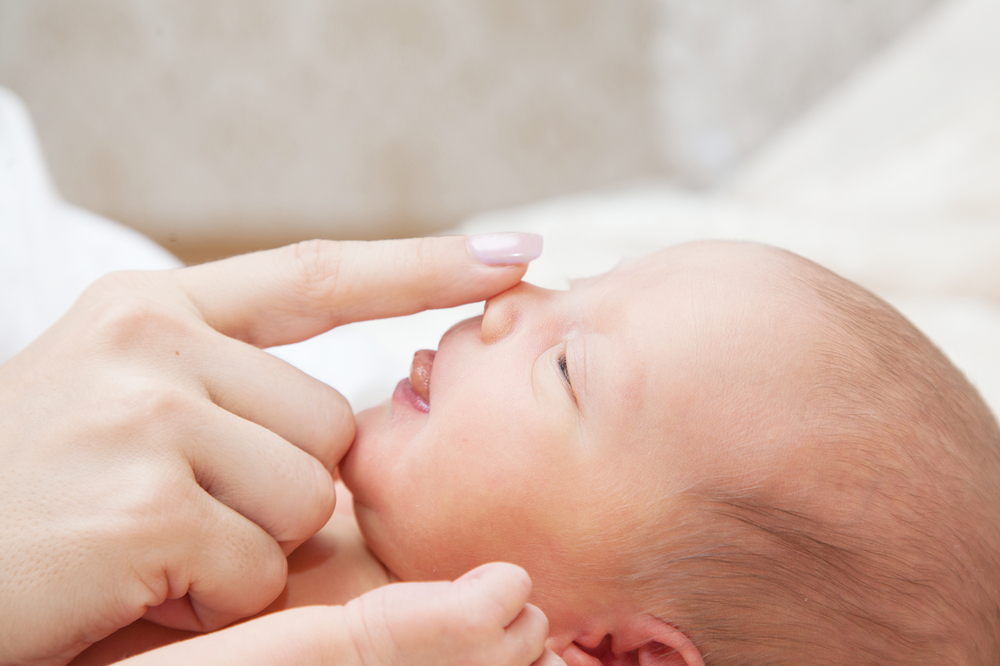
Your baby tin olfactory property you. (Photo Credit : Balaguta Evgeniya/Shutterstock)
The baby inside the womb experiences waves of the amniotic fluid while it sucks its thumb and during swallowing. Manipulating the odor of the amniotic fluid for experiments has shown changes in infant response. They show allure towards the amniotic fluid odour, conspicuously pointing towards prenatal learning.
After birth, the infant instinctively turns towards the mother'due south breast, equally it is an effective source of the amniotic odor. Every bit early on as the first day, crying infants are soothed when brought near the mother because of the familiar maternal odor.
Moms normally remain in the closest contact with the baby, while feeding and at other times. Thus, the infant is exposed to the maternal odour the most. Information technology as well begins to recognize that this olfactory property is the i providing it with nutrition and condolement. As a result, it develops a preference for the maternal smell.
Infants prefer parts of clothes that were closer to the armpit of their mother, every bit compared to dress worn by other mothers. Maternal odor also seems to help the neonate locate the nipple. Research shows how newborns discriminate between maternal odors and odors produced past other unfamiliar, just lactating women.

Bottle-fed babies testify a reduced preference for their maternal odor, equally compared to breast-fed babies. This implies that maternal odour exposure plays a vital function in developing recognition past the baby.
Sense of vision
Even though the sense of vision is not fully adult at the fourth dimension of nativity, babies tin can surprise you lot in diverse ways! For a neonate, its sense of sight is blurred and fuzzy for objects unless they are close enough to focus.
Inquiry has shown that babies tend to process faces more than other objects. Consequently, babies love staring at faces! Even so, they are not able to recognize them until about 3-6 months of age. Infants at this age are able to recognize and differentiate their mum'due south face from others.
Before this historic period though, infants are unable to differentiate. The ability to recognize apparently increases with exposure to the maternal face.
In-utero sense of touch
Research conducted past the University of Dundee, Scotland used 3D real-time sonography to record the fetal response to caressing of the mother's babe bump. Women in their third trimester were called for this research.
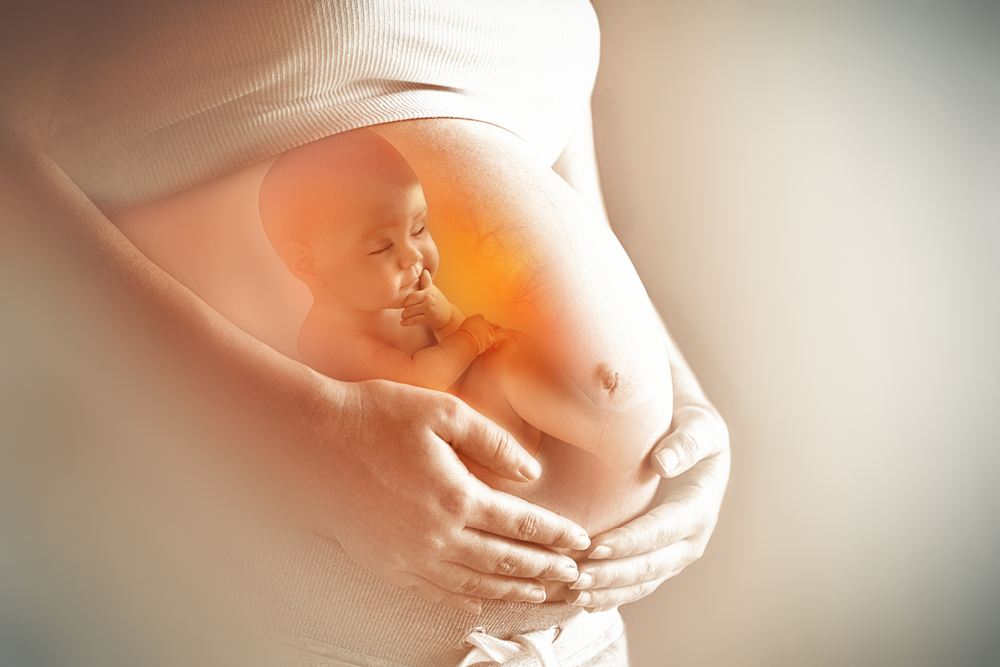
Fetus responds to maternal caressing of the baby crash-land. (Photo Credit : zffoto/Shutterstock)
The research found that the baby responded to the female parent's touch of her abdominal region more than it did to a stranger's touch on. The baby would, generally, reach out to the uterine wall when its mum was caressing her bump.
Conclusion
We might experience that newborns are new to the earth with admittedly no knowledge of annihilation. Still, babies are smart enough to brand sure that is not the example. They come out into the outer globe with an advisable amount of knowledge to recognize their primary caregiver—their mother—and they gradually learn more about her within just a few months! And while they are learning about you, you lot tin can learn about their cuteness here!
Recommended Video for you:
Suggested Reading
-
Newborn Mothers: When a Baby is Born, and so is a Mother. -
Pregnancy, Childbirth, and the Newborn: The Consummate Guide


Aid us make this commodity amend
Source: https://www.scienceabc.com/humans/does-a-human-newborn-recognize-its-mother-how.html
0 Response to "How Do U Know Ur Baby Differentiates Between Mommy and Others"
Post a Comment